
Structure alone is not enough.
Industrial data platforms have improved access to data. Many can organise data into hierarchies or namespaces, making it easier to find.
But organising data is not the same as understanding it.
What’s often missing is how assets, systems and processes actually relate to each other – and how those relationships impact operations.
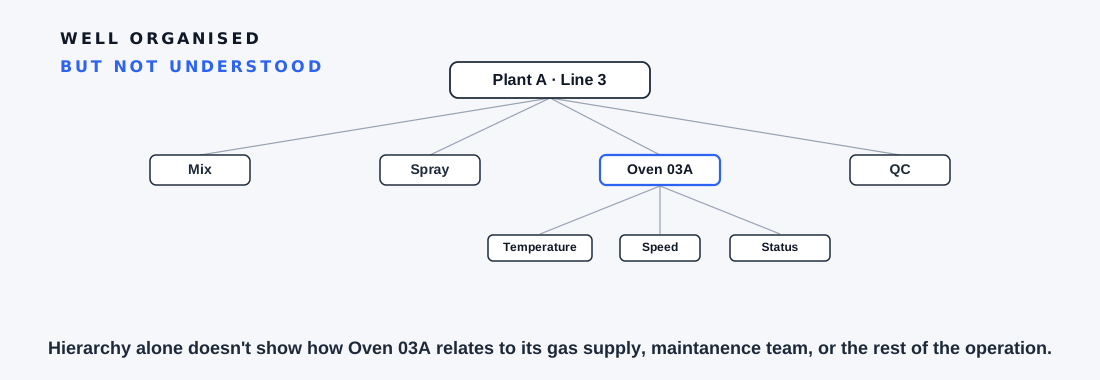
Tags and hierarchies don’t capture:
How assets interact within a process
Tag lists don’t show how inputs, outputs and dependent systems connect.
How systems depend on each other
System dependencies answer most operational questions – but tags don’t carry them.
How changes ripple across the operation
Without relationships, cause-and-effect lives in someone’s head, not in the data.
Relationships model how operations actually work.
ARDI moves beyond organising data – it models how your operation functions.

ARDI defines relationships across:
Assets and equipment
Pumps, ovens, valves and lines modelled as the things they really are, with their own properties and operating limits.
Processes and flows
How material, energy and product move through the operation – captured as relationships between assets and steps.
Systems and data sources
Historian, MES, ERP, IoT and files connected to the assets they describe, rather than being independent silos.
This creates a connected, operational model where data is understood in context:
Context for every reading
A reading isn’t just a number on a tag – it’s a property of an asset, in a process, on a line.
Modelled once, reused everywhere
Define how the operation fits together once, then use that model in dashboards, analytics, 360° environments, alerts and reports.
Knowledge that compounds
Engineers and analysts no longer need to re-explain how the plant works for every new piece of work.
Connect every source. Copy nothing.
ARDI consolidates access to your operational data – connecting through drivers to historians, SCADA, MES, ERP, IoT, document management, maintenance systems and files.
Nothing is duplicated. The data stays in its source systems; ARDI makes every source available through one connected interface – to people, applications, dashboards and AI.
The result is a single place to find anything about your operation, with the source of truth intact – no replicated histories, no infrastructure struggling with 20Hz signals, no forecasts drifting out of sync.
ARDI avoids this by working directly with source systems wherever possible.
Data stays where it is
ARDI uses the data from existing historians, SCADA, MES, ERP, IoT and files – no replatforming, no new data repository (1).
Context is applied at the point of use
Relationships sit in the access layer, so applications and users see context-rich data.
Analysis and calculations at the source
Analysis and live calculations happen alongside your operational systems – no cloud round-trip, no replication delay, just near real-time results.
No need to backfill
Existing history is available immediately – no time-consuming (and often impossible) task of copying years of recorded data into a separate lake.
Built for high-speed signals
High-frequency data (20Hz and beyond) flows through directly – no separate database struggling to keep up with the volumes operational systems already handle.
Forecasts and corrections stay in sync
ARDI always reads from the most accurate recording in the source system, so forecasts, back-corrections and late-arriving data don’t create replication issues.
(1) Where it makes sense, data can also be stored via ARDI.
Context for AI, not just data.
AI tools are only as useful as the context they have to work with.
Most platforms hand AI a sea of tags or a copy of your data lake. ARDI hands it a model of your operation – the assets, processes, dependencies and live signals already connected by the relationships that explain how things actually work.
ARDI gives AI agents what they need to be useful in industrial settings:
Agents reason over relationships, not tag lists
An agent asking “why did Oven 03A drop?” can follow the relationships – power, batch, controller, team – instead of guessing from a flat list of names.
Live data, in context, every time
Each value an agent sees is already tied to its asset, process and operation – so answers are grounded in the same model engineers and operators use.
One model for humans and agents
The same relationship model powering dashboards, alerts and reports feeds AI directly – so agents and people stay aligned on how the operation actually works.
MCP-native for agent platforms
ARDI exposes its model and live data through MCP – the standard for grounding AI in real context – so agents and AI tools plug in without bespoke connectors.
Get machine setup right the first time.
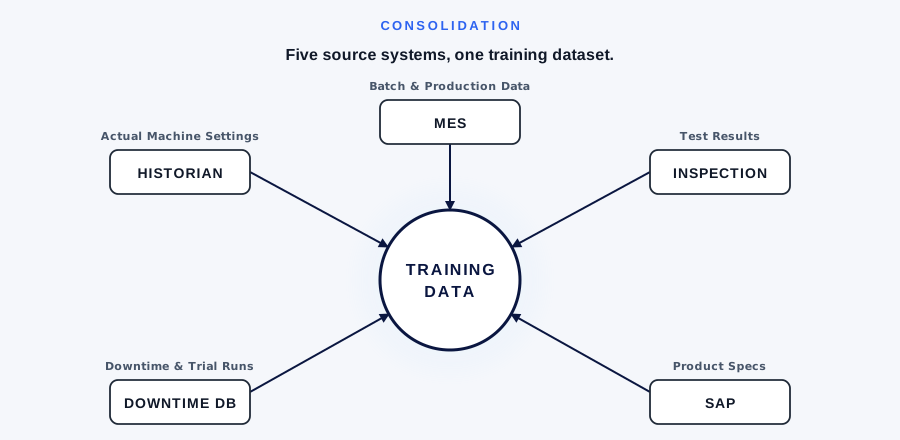
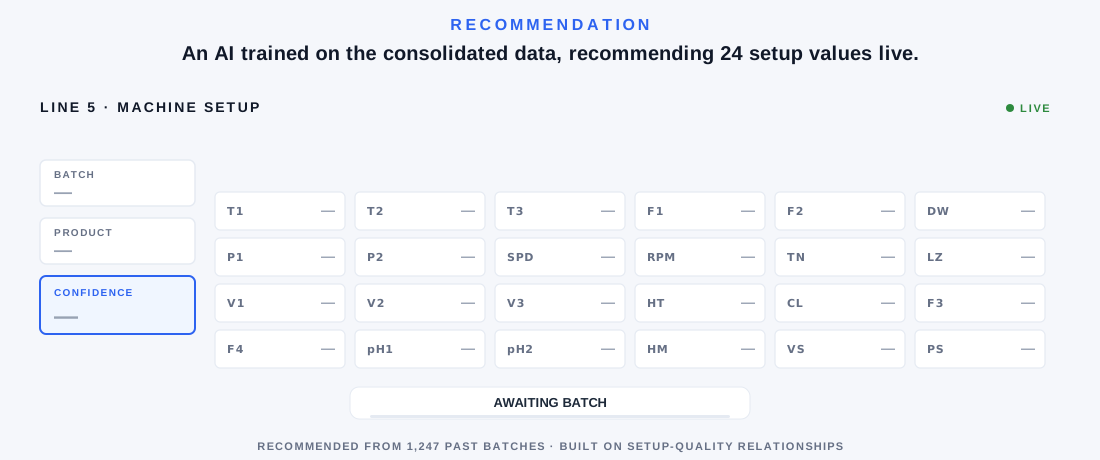
A manufacturer was configuring 24 machine settings for every product batch by hand, leaning on operator experience and trial runs. ARDI modelled the relationship between setup and quality, built an AI model and a lookup model from the cleaned data, and delivered tailored recommendations live – through on-screen displays, alerts and queries.
Less time and material lost to trial runs
Recommendations land before the run starts, so setup converges on the first attempt instead of the third or fourth.
Consistency across shifts
Every operator sees the same model-derived setup values, so quality and output stop tracking who’s on shift.
One model, many uses
The same setup-quality relationships now drive diagnostics, operator performance and forward planning.
Modelled once on the relationship between setup and quality – reused everywhere a setup decision needs to be made.
What ARDI is, how it’s built, and how it gets delivered.
What is ARDI?
The relationship layer for your industrial data – what it does, what it doesn’t, and how it fits.
ARDI Components
Inside ARDI’s architecture – the Core that holds context and the Addons that turn it into practical capabilities.
Optrix Services
How a focused engagement turns into a measurable outcome – like the one you just read.
Start with one real problem.
The fastest path to value is not a giant transformation program. It is a focused use case that proves the value of connected, contextualised industrial data.